


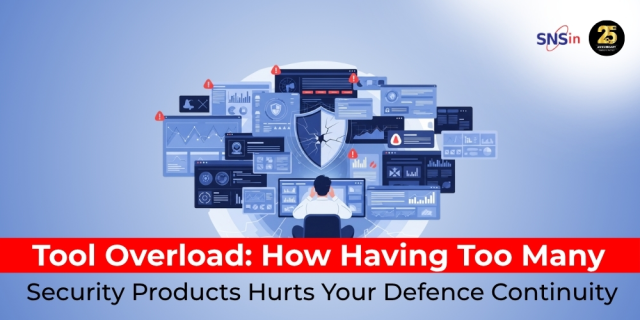
In today’s fast-moving cybersecurity world, more tools often seem like the answer.
Every new breach leads to another product promise: “This tool can detect it,”“That platform can stop it.”
But somewhere along the way, the average security stack has turned into a tangled web of dashboards, alerts, and overlapping technologies.
A recent Gartner survey found that large enterprises use an average of 76 different security tools, while mid-sized firms often juggle between 25 and 45. Instead of better protection, this complexity is creating fatigue, confusion, and higher risks.
This is the story of tool overload — the hidden vulnerability inside modern cybersecurity.
1. The Problem Nobody Wants to Admit: “More” Isn’t Always “Better”:
For years, cybersecurity teams have been in a constant race against attackers. Every time a new threat emerges, a new tool follows — each claiming to be essential. Firewalls, SIEMs, XDRs, CASBs, IAMs, DLPs, SASEs, SOARs… the list goes on.
But in the rush to cover every corner, many organisations have accidentally created fragmented security environments where tools don’t talk to each other, alerts overlap, and visibility actually decreases.
Instead of simplifying response, they’ve built a maze.
Real-world example
A BFSI firm in Dubai deployed 32 tools across its infrastructure. When a ransomware incident occurred, alerts came from five different systems — each reporting fragments of the same issue.
The team spent hours correlating them instead of responding, giving attackers precious time to spread laterally. By the time the root cause was isolated, the breach had already caused customer downtime and data encryption.
The irony? They weren’t short of tools — they were short of clarity.
2. Why Tool Sprawl Happens:
Tool overload rarely comes from bad intentions. It’s the natural result of fast-changing threats and organizational silos. Let’s break down the root causes.
a) Reactive purchasing
Security budgets often grow after an incident or audit. Instead of strategic planning, many purchases are reactionary:
“We got hit by phishing — let’s buy an email security tool.”
“Our auditor flagged endpoint visibility — let’s get another EDR.”
Each tool solves a problem in isolation but creates new integration challenges.
b) Vendor fragmentation
Every vendor claims end-to-end protection, but in reality, their tools often cover narrow areas. Companies mix vendors, each with their own dashboards and policies — creating what analysts call “security islands.”
c) Skills gap & fear of missing out
Many IT managers feel safer with more tools because they lack confidence in existing coverage or lack specialists to fine-tune them.
“If we don’t buy this one, what if we miss the next zero-day?”
That “fear of missing out” (FOMO) leads to overlapping capabilities.
d) Lack of consolidation strategy
Mergers, hybrid clouds, and distributed teams mean security grows organically — not by design. Each department buys its own solution. Over time, no one knows the full picture.
3. The Hidden Costs of Tool Overload:
Let’s look beyond the license fees. The real cost of tool overload comes in time, visibility, and response.
a) Alert fatigue
When every product sends alerts, the SOC ends up drowning in noise. Analysts stop differentiating between what’s urgent and what’s routine.
The result? Critical alerts get missed, while low-priority ones consume hours.
According to IBM, 45% of alerts go not investigated due to volume overload.
b) Integration complexity
Each new tool means new APIs, agents, logs, and patch schedules.
Instead of defending, teams spend weeks just keeping tools up-to-date and ensuring compatibility. Disconnected tools mean fragmented data — forcing analysts to jump between 10–20 dashboards.
c) Delayed response time
In an incident, speed is everything. But too many tools can slow things down. Without unified visibility, it’s hard to correlate data, trace the attack chain, and act decisively.
d) Operational costs
Every product requires training, maintenance, and monitoring. Licensing + manpower costs can exceed the benefit.
Many companies pay for tools they barely use — known as “shelfware.”
e) Increased attack surface
Ironically, each tool adds potential vulnerabilities — especially if not patched or properly configured. Attackers often exploit misconfigured security products (e.g., exposed SIEM dashboards, outdated VPNs, or unmonitored endpoints).
4. How Tool Fatigue Affects People — Not Just Systems:
Cybersecurity is not just a technology challenge — it’s a human one.
- Burnout: SOC analysts face 1000+ alerts a day. Many leave due to mental fatigue.
- Skill dilution: Instead of mastering a few platforms, teams juggle many — becoming generalists with shallow expertise.
- Onboarding delays: New hires take longer to learn complex toolchains, slowing team readiness.
- Decision paralysis: With multiple dashboards giving conflicting data, teams hesitate to act.
When fatigue sets in, risk acceptance increases — and that’s when breaches happen.
5. Tool Overload = Weak Security Posture:
Let’s connect the dots. A cluttered toolset doesn’t just cause inconvenience — it weakens your entire defence strategy.
- Fragmented visibility → Missed attack correlations
- Overlapping controls → Redundant spending
- Unclear accountability → Finger-pointing during incidents
- Inconsistent policies → Compliance risks
In cybersecurity, simplicity is strength. Attackers thrive on confusion. The more complex your defense, the easier it is to find a gap.
6. The Rise of Security Consolidation:
The industry is now shifting towards creating platforms — consolidating multiple functions into fewer, integrated systems.
Gartner calls this “security tool rationalization.” Instead of 40 standalone products, many enterprises are moving toward unified suites like XDR, SSE, or SASE, where detection, response, and visibility live in one place.
Consolidation Benefits:
- Unified dashboards for faster investigation
- Consistent policy enforcement across endpoints, cloud, and network
- Easier automation through SOAR/SIEM integration
- Lower cost and training overhead
- Reduced alert fatigue
However, consolidation doesn’t mean “one vendor for everything.” It means building a cohesive ecosystem that fits your business needs.
7. How to Start Reducing Tool Overload:
Here’s a practical roadmap you can use:
Step 1: Inventory your existing tools
List every tool — including free, open-source, and departmental ones. Capture what it does, who uses it, and its purpose. You might be surprised how many overlap.
Step 2: Map business value
For each tool, ask:
- Does this protect a critical asset?
- Does it integrate with others?
- When was the last time it generated useful insight?
- Rank tools by business impact vs complexity.
Step 3: Identify redundancies
If two tools do similar things (e.g., two EDRs, multiple cloud monitors), keep the one with better integration or vendor support.
Step 4: Prioritize interoperability
Favor tools that share APIs, integrate with your SIEM/XDR, and allow unified reporting.
Step 5: Adopt “platform thinking”
Shift from isolated purchases to unified ecosystems. Look for vendors offering modular expansion — where you can add capabilities without adding complexity.
Step 6: Automate and orchestrate
Use SOAR platforms or automation scripts to unify alerts and response playbooks.
Step 7: Review quarterly
Technology evolves fast. Set a quarterly cadence to review new integrations and retire outdated or unused tools.
9. Case Study: Streamlining for Strength:
A healthcare provider in Chennai managed 28 tools across its on-premise and cloud systems. Post-audit, they consolidated to 11 integrated platforms, connecting EDR, email security, and threat intelligence into a single SOC dashboard.
Results:
- Incident response time reduced by 54%
- Alert fatigue dropped by 60%
- Annual licensing costs cut by ₹38 lakhs
- Staff satisfaction improved — “less chaos, more control”
Simplification didn’t weaken their security posture — it strengthened it.
10. Building a “Lean Security Stack” Mindset:
A lean stack focuses on effectiveness, not quantity.
Principles of a lean stack:
- Visibility over volume – one pane of glass for all critical assets
- Integration over isolation – tools must talk to each other
- Automation over manual review – free your analysts from repetitive triage
- Resilience over redundancy – avoid buying 3 tools for 1 task
- Outcome over ownership – focus on measurable impact (MTTR, dwell time, uptime)
When the SOC team spends less time managing tools, they spend more time defending.
10. The Future: Converged Platforms & AI-Assisted Defence:
The next evolution of cybersecurity isn’t more tools, it’s smarter ecosystems.
- Unified threat platforms (XDR/SASE): Integrating endpoint, cloud, and network telemetry.
- AI-driven correlation: Turning 1000 alerts into one actionable incident.
- Adaptive automation: Learning from previous attacks to self-tune defences.
- Zero-trust by design: Identity-driven security replacing perimeter-based tools.
Soon, success won’t be measured by how many tools you own — but by how seamlessly they work together.
Final Thoughts:
Cybersecurity tool overload is like over-medicating an illness — too many prescriptions, not enough diagnosis. A stronger defence doesn’t mean adding more software; it means aligning the right tools, people, and processes.
Simplify to amplify. Because in the age of hyper-connected threats, clarity is the ultimate defence.
About SNS:
At Secure Network Solutions (SNS), we help businesses simplify cybersecurity with integrated, end-to-end protection — from cloud and email security to identity management and compliance.
With 25+ years of experience, SNS empowers organizations to strengthen defences, eliminate tool chaos, and build true operational resilience.
 For more information, reach out to us at enquiry@snsin.com