

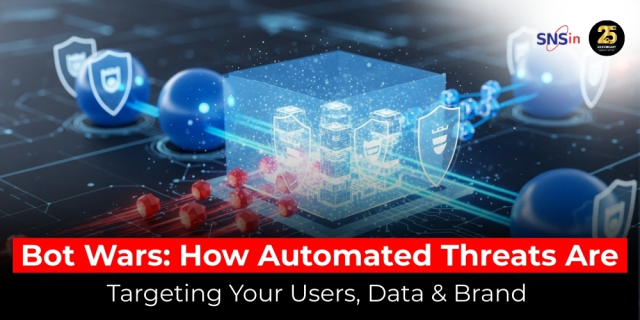
Bot Wars
How Automated Threats Are Targeting Your Users, Data & Brand
In 2025, over 45% of all internet traffic comes from bots — and nearly three-quarters of that is malicious.
These aren’t the simple web crawlers of the past; today’s bots can mimic humans, steal data, flood APIs, scrape prices, and take over accounts — often without being detected.
For businesses, this means that the next major breach or brand crisis might not come from a hacker sitting in a dark room, but from a fleet of automated scripts operating at machine speed.
This blog explains how bot attacks work, what they target, the real business impact, and most importantly — how to fight back with visibility, resilience, and smart automation.
1. Why This Matters Now:
Bots have become the frontline of modern cyber warfare.
As digital ecosystems expand — from websites and APIs to mobile apps and partner portals — every access point becomes a potential target.
In 2025, several trends have made bots more dangerous:
- AI-Generated Bots: They adapt and learn faster than rule-based filters.
- Scalable Botnets: Millions of compromised IoT devices can execute coordinated attacks.
- Cheap-as-a-Service Attacks: DDoS or credential-stuffing bots can be rented for as little as $10/hour.
- Fake Traffic Inflation: Marketing teams struggle to trust analytics because bots distort engagement metrics.
For executives, this isn’t just an IT issue — it’s a business continuity and brand trust problem.
2. Understanding the Bot Landscape:
Not all bots are bad. But distinguishing between good bots and malicious automation is now critical.
Good Bots
- Search engine crawlers (Googlebot, Bingbot)
- Monitoring tools (UptimeRobot, Pingdom)
- Legitimate API integrations
Bad Bots
- Credential Stuffers → Try username-password combinations stolen from breaches
- Scrapers → Copy content, pricing, and IP
- Spammers → Post fake comments or reviews
- Scalpers → Buy out limited stock for resale
- DDoS Bots → Flood services with fake traffic
- API Exploiters → Abuse exposed endpoints for data extraction
The Evolution of Malicious Bots
Older bots were easy to spot — repetitive patterns, same IPs, no browser headers. Modern ones are “human-like”, using:
- Rotating IP addresses
- Residential proxies
- Headless browsers
- CAPTCHA bypass tools
- AI-based behaviour mimicry
They can even simulate mouse movement, click delays, and device fingerprints, making them nearly indistinguishable from real users.
3. Common Types of Bot Attacks in 2025:
1. Credential Stuffing
Attackers use stolen username-password pairs from previous breaches to log into other platforms (because users often reuse passwords).
- Impact: Account Takeovers (ATO), data theft, fraud.
- Industries hit hardest: Banking, SaaS, retail.
2. Web Scraping
Automated bots extract pricing, content, and even images.
- Impact: Competitors gain unfair intelligence; your SEO ranking drops due to duplicate content.
3. Inventory Hoarding / Scalping
Bots reserve limited stock items — from concert tickets to GPUs — preventing legitimate buyers from purchasing.
- Impact: Customer frustration, loss of trust, and fake demand data.
4. DDoS and Layer-7 Floods
Bots send millions of HTTP requests to overwhelm applications or APIs.
- Impact: Downtime, slower response times, and costly bandwidth bills.
5. API Abuse
Bots target API endpoints to harvest data or trigger transactions without user consent.
- Impact: Unauthorized data extraction, privacy violations, compliance risks.
6. Fake Account Creation
Bots create fake profiles or spam forms, polluting CRMs and email lists.
- Impact: Poor lead quality and increased email bounce rates.
4. The Financial and Operational Cost of Bot Attacks:
According to a 2025 Akamai report:
- $7 billion is lost annually to automated bot-based fraud.
- 67% of companies admit they can’t fully distinguish human from bot traffic.
Bot attacks create hidden costs across departments:
- Operations: Server overload and downtime.
- Marketing: Misleading analytics and wasted ad spend.
- Security: More false positives, higher alert fatigue.
- Customer Service: Increased complaints from ATO victims.
A single unmitigated bot campaign can cause data leakage, inflated KPIs, or customer churn within weeks.
5. Best Practices — How to Defend Against Malicious Bots:
Fighting bots requires a multi-layered defense strategy — combining network-level controls, application logic, and behavioural analysis.
1. Protect Entry Points
- Restrict access to admin and login pages using CAPTCHA, 2FA, and IP whitelisting.
- Implement rate-limiting to block repeated requests from the same source.
- Disable or secure unused APIs and endpoints.
2. Identify Human vs. Bot Behaviour
Modern defences analyse mouse movement, session duration, click intervals, and request headers to detect non-human activity. Use tools that can fingerprint browsers and devices without affecting user experience.
3. Deploy Real-Time Threat Intelligence
Attackers reuse infrastructure (proxies, IP ranges, malware networks).
Integrate threat feeds that automatically block requests from known bad sources.
4. Use Web Application Firewalls (WAF) and Bot Management
A WAF filters web traffic before it hits your server. Advanced WAFs include bot management modules that use ML to distinguish legitimate users from automated scripts.
5. Secure APIs
Since most modern apps rely on APIs, they’re a prime bot target.
- Enforce authentication and token validation.
- Rate-limit sensitive API endpoints.
- Log and monitor all API activity.
6. Monitor DNS and Infrastructure
Attackers often exploit DNS records or CDN misconfigurations to reroute botnets.
Regular audits and DNSSEC help maintain integrity.
7. Educate Teams and Partners
Humans remain the weakest link. Train marketing, sales, and IT teams to recognize fake leads, data anomalies, and traffic spikes.
6. Case Study — The Price of Ignoring Bots:
Scenario:
A mid-size online retailer noticed sudden spikes in web traffic and “sold-out” items despite minimal genuine customer activity.
Investigation:
Bots were scraping product listings and auto-purchasing high-demand items, which were later resold on third-party marketplaces at inflated prices.
Impact:
- Customer complaints increased by 300%
- Monthly ad spend wasted on bot clicks
- Inventory management data became unreliable
After Mitigation:
The company implemented a layered WAF + bot detection system, set strict rate limits, and secured APIs. Within two weeks, fake traffic dropped by 90%.
Lesson:
Ignoring bots can break the trust cycle between your brand and customers — and fixing that reputation takes much longer than fixing a server.
7. Future Outlook — The Next Generation of Bots:
Bots are getting smarter, faster, and stealthier.
Here’s what to expect beyond 2025:
- AI-Empowered Bots: Capable of self-learning and adapting to defenses.
- Voice and Chatbot Impersonation: Fake voice interfaces mimicking customer support.
- Deepfake-Driven Fraud: Combining visual and data manipulation for scams.
- API-Only Attacks: Entire campaigns targeting machine-to-machine interfaces.
- Regulatory Pressure: Governments are drafting anti-bot legislation, especially for e-commerce and finance.
Prediction: By 2027, bot management will become a standard cybersecurity compliance requirement — similar to how firewalls became mandatory a decade ago.
8. Building a Bot Defense Strategy for Your Organization:
A modern anti-bot strategy should blend technology, process, and people.
Step 1: Assess
- Map your attack surface — websites, APIs, apps, and DNS.
- Identify which endpoints see unusual traffic patterns.
Step 2: Implement
- Deploy WAFs, rate-limiting, and CAPTCHA mechanisms.
- Integrate behavioural analytics and IP reputation systems.
Step 3: Monitor
- Use dashboards to track traffic sources and threat categories.
- Review weekly or monthly reports to refine rules.
Step 4: Optimize
- Tune detection thresholds to reduce false positives.
- Automate blocking policies based on data trends.
Step 5: Collaborate
- Share threat intelligence with partners and industry networks.
- Conduct regular tabletop exercises to test readiness.
9. Executive Takeaways:
- Bots are now business threats, not just technical nuisances.
- They target revenue, brand credibility, and customer trust simultaneously.
- Automation works both ways — use it to defend, not just to operate.
- Continuous monitoring and adaptive rules are key to staying ahead.
- A proactive, data-driven defense strategy strengthens cyber resilience and reputation.
10. Conclusion — Fighting the Invisible Enemy:
The modern internet runs on automation — but so do attacks. Every business that operates online is already part of the Bot Wars, whether they realize it or not.
The choice for leaders in 2025 is simple:
- React after damage is done, or
- Build a proactive, intelligent defense that keeps your brand, data, and customers safe.
In cybersecurity, visibility equals control — and control equals trust. It’s time to make sure your defences evolve as fast as the threats.
About SNS – Your Cyber Security Partner:
Like a family doctor, organization need a trusted cybersecurity partner who can guide them in 360 degree protection.
Secure Network Solutions (SNS) has been protecting businesses for last 25 years as a trusted advisor and implementor of top cyber security solutions.
For any cyber security requirement to enhance your cyber space write to us at enquiry@snsin.com
66 post views